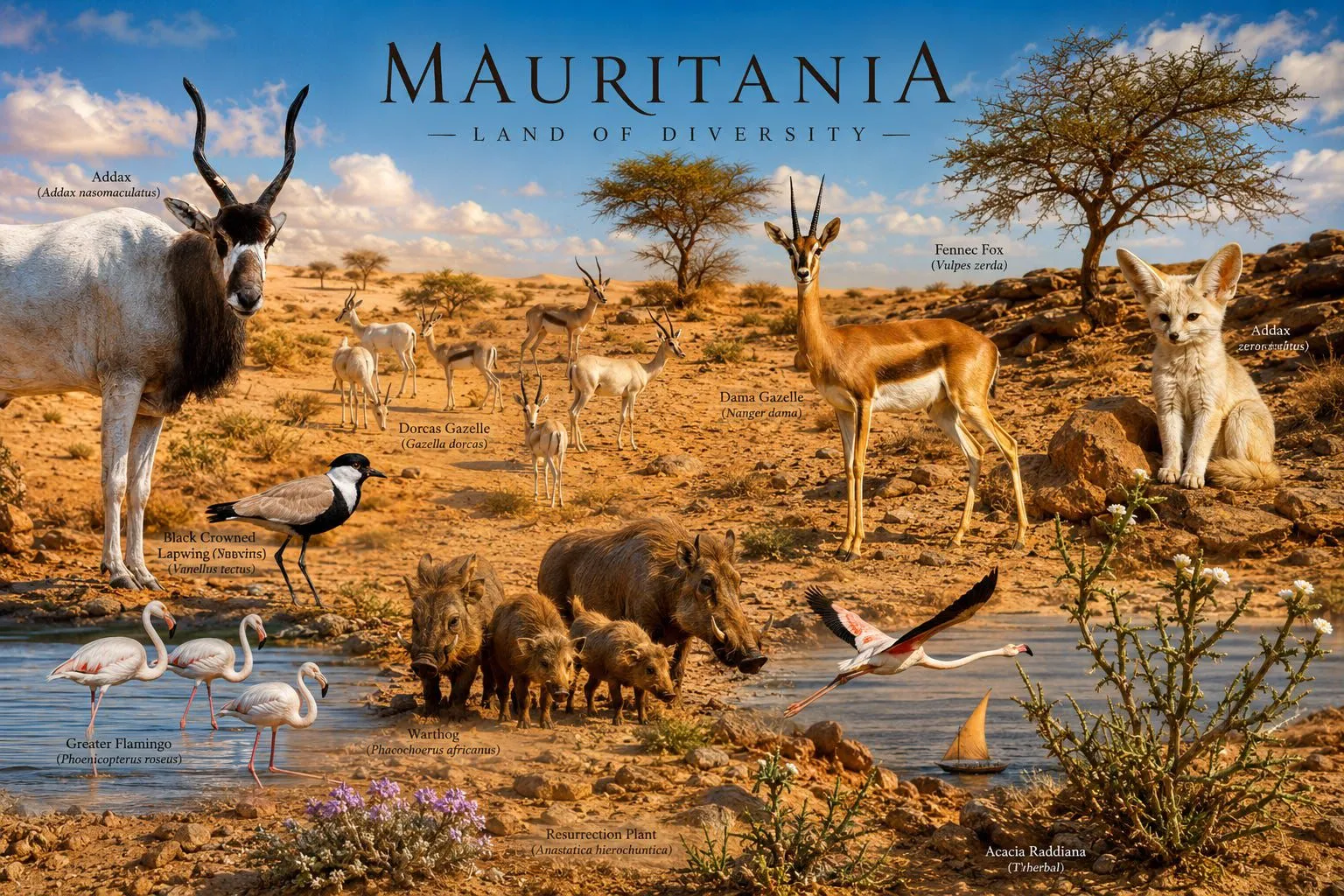
Mauritania’s Flora and Fauna: Discovering the Hidden Wildlife of the Sahara and Atlantic Coast
Mauritania’s Flora and Fauna: Discovering the Hidden Wildlife of the Sahara and Atlantic Coast
When people think of Mauritania, they often imagine endless dunes, ancient caravan routes, and vast stretches of the Sahara Desert. While these images are true, they reveal only part of the story. Beneath the country’s seemingly harsh landscapes lies a remarkable world of biodiversity shaped by the meeting of the Sahara, the Sahel, and the Atlantic Ocean.
Mauritania is home to an extraordinary variety of ecosystems: windswept deserts, rocky plateaus, oasis valleys, wetlands, savannas, and one of the richest marine environments in West Africa. These environments support unique plant and animal species that have adapted to survive in some of the most extreme conditions on Earth.
From migratory flamingos and Atlantic dolphins to desert foxes, ancient crocodiles, acacia forests, and oasis date palms, Mauritania’s flora and fauna reveal a side of the country that many travelers never expect.
A Land of Contrasting Ecosystems
Mauritania’s geography creates several distinct ecological regions, each with its own plant life and wildlife.
The northern and central parts of the country are dominated by the Sahara Desert. These areas consist of towering dunes, gravel plains, rocky mountains, dry valleys, and isolated oases. Rainfall is extremely limited, temperatures are intense, and survival depends on extraordinary adaptation.
Further south, the landscape gradually transitions into the Sahel — a semi-arid zone where grasses, shrubs, and scattered trees appear after seasonal rains. This region supports pastoral communities and a greater concentration of wildlife.
In the south, the Senegal River Valley provides wetlands, floodplains, and fertile land rich in birdlife and aquatic species. Along the Atlantic coast, Mauritania possesses one of the world’s most important marine and migratory bird ecosystems.
Desert Flora: Life Against the Odds
At first glance, the Mauritanian desert may appear lifeless. Yet the Sahara contains an impressive range of plants specially adapted to survive heat, drought, and poor soils.
Desert vegetation includes:
- Thorny shrubs and hardy grasses
- Salt-resistant plants
- Seasonal herbs and sparse flowering species
Many desert plants survive through deep root systems capable of reaching underground water sources. Others store water within their tissues or reduce moisture loss through tiny leaves and waxy surfaces. Plant life is especially concentrated near oases, seasonal riverbeds (wadis), rocky depressions, and underground springs.
The Importance of Acacia Trees
One of the most important trees in Mauritania is the acacia. Highly adapted to dry climates, they play a critical ecological role by preventing soil erosion, providing shade, and supporting traditional livelihoods.
Oasis Ecosystems and Date Palms
The oasis landscapes of regions such as Adrar and Tagant are among Mauritania’s most beautiful natural environments. At the heart of these oases stands the date palm, providing nutritious fruit, shade, and construction materials while creating cooler microclimates for other crops.
Wildlife of the Mauritanian Desert
Mauritania’s deserts are home to remarkable animals adapted to some of the harshest climates on Earth.
The Fennec Fox: Spirit of the Sahara
One of the most iconic desert animals is the fennec fox. Recognizable by its enormous ears, which help release body heat, this agile and elusive nocturnal creature symbolizes the mystery and beauty of Saharan wildlife.
Antelopes of the Sahara
Historically, Mauritania supported populations of magnificent desert antelopes such as the Addax, Oryx, and Dorcas gazelle. The addax, in particular, is one of the world’s rarest antelopes, capable of surviving long periods without drinking water. Unfortunately, these species have declined dramatically due to hunting and habitat degradation.
Reptiles and Desert Survivors
Common species include geckos, monitor lizards, chameleons, and desert snakes. Among the most extraordinary is the West African crocodile, with small populations surviving in isolated desert wetlands known as gueltas — living reminders of a time when the Sahara was much wetter.
Mauritania: A Paradise for Birds
Mauritania is one of Africa’s most important countries for birdlife, with more than 500 species recorded. The country’s wetlands and coastal lagoons provide critical feeding grounds for millions of birds each year.
Banc d’Arguin National Park: A Global Treasure
Located along the Atlantic coast, this UNESCO World Heritage Site is considered one of the world’s most important bird sanctuaries. Its islands, sandbanks, and mudflats host millions of migratory birds including flamingos, pelicans, herons, and spoonbills.
Diawling National Park
In southern Mauritania, this park preserves important wetland ecosystems associated with the Senegal River, playing a crucial role in fish breeding and bird migration.
Marine Life Along the Atlantic Coast
Mauritania’s Atlantic waters are among the richest fishing grounds in Africa. Cold ocean currents bring nutrients to the surface, supporting large fish populations, dolphins, whales, sharks, and sea turtles. Marine mammals such as bottlenose dolphins, pilot whales, and orcas are frequently observed along the coast.
Environmental Challenges
Despite its ecological richness, Mauritania faces serious environmental pressures including desertification, climate change, overgrazing, and overfishing. As temperatures rise and rainfall becomes more unpredictable, conservation efforts are essential to protect endangered species and fragile habitats for future generations.
Conclusion
Mauritania is far more than a land of sand dunes and empty horizons. It is a country of hidden biodiversity, dramatic ecosystems, and extraordinary adaptation. From the Atlantic coast to the Sahara Desert, its flora and fauna tell a story of survival and resilience in one of the world’s most challenging environments.
For travelers, researchers, and nature lovers, Mauritania remains one of Africa’s most fascinating and least explored natural destinations.
Sources
- Natural World Safaris – Mauritania Wildlife
- Encyclopaedia Britannica – Plant and Animal Life of Mauritania
- Wikipedia – Wildlife of Mauritania
- Earth Site – Exploring the Rich Flora and Fauna of Mauritania
- FloraFaunaFun – Fauna of Mauritania
Written by
Wakaya Tours